


TuneCable Tidal Music Converter Review 2026: HiRes FLAC Tested
Let's be honest. Most reviews you'll find for TuneCable Tidal Music Converter rehash the feature list without any real testing. I decided to do things differently. So I bought a license, installed the latest version, and spent a week putting this Tidal converter through its paces.
I timed conversions. I ran a spectral analysis to verify audio quality. I checked ID3 tags across dozens of tracks. I read through Trustpilot to separate genuine user feedback from noise. Here's what I actually found, with a special focus on Tidal to FLAC performance.
Part 1. What Does TuneCable Actually Do?
TuneCable Tidal Music Converter is a desktop tool that lets you download and convert Tidal tracks, playlists, and albums into DRM-free audio files. It works by decrypting Tidal's encrypted streams and outputting them as standard formats: MP3, AAC, FLAC, WAV, AIFF, and ALAC.
Available for Windows and Mac (desktop only), it supports all Tidal account tiers, including Free Trial, Individual, Family, Student, and DJ Extension.
But here's the thing that actually caught my attention: TuneCable claims to support Tidal's HiRes FLAC tracks (up to 24-bit/192kHz), which is the highest-quality audio tier available. Most Tidal converters either can't handle HiRes FLAC at all or downsample it to standard CD quality. So that became my primary testing focus. Let's see.
Part 2. How I Tested TuneCable: Speed, Quality, Metadata & UI
All tests were run on a Windows Pro 11 (64-bit) machine with a stable 100Mbps connection, using a Tidal Individual account. I tested across four key areas: audio quality, speed, metadata preservation, and ease of use.
🔷 1. Audio Quality: Is It Really Lossless?
This is where things got interesting. Tidal currently offers three audio quality tiers:
- Low: Up to 320 kbps
- High: 16-bit / 44.1 kHz
- Max: Up to 24-bit / 192 kHz
I tested all three tiers to see what TuneCable actually delivers. Using Spek spectral analysis, I compared the output files against the original Tidal streams.
| Tested Tier | Track | Output Format | Actual Quality |
|---|---|---|---|
| Low | Getting Older by Billie Eilish | AAC | 320kbps; 44.1kHz |
| High | Taste by Sabrina Carpenter | FLAC | 1881kbps; 16-bit / 44.1kHz |
| Max | Welcome to the Machine by Pink Floyd | FLAC | 3008kbps; 24-bit / 192kHz |
The FLAC outputs matched the expected specifications for each tier. The High tier tracks came through as 16-bit/44.1kHz FLAC, and the Max tier tracks retained their full high-resolution depth (up to 24-bit/192kHz) according to the file properties and spectral analysis. The Spek showed clean frequency responses extending beyond 22kHz for the HiRes tracks, which is a good indicator that the conversion preserved the high-resolution content rather than downsampling it. While I can't verify bit-for-bit identity without access to Tidal's original source files, the output files appear to be genuine lossless FLAC with the correct sample rate and bit depth intact, which is exactly what I'd hope to see from a converter claiming HiRes support.
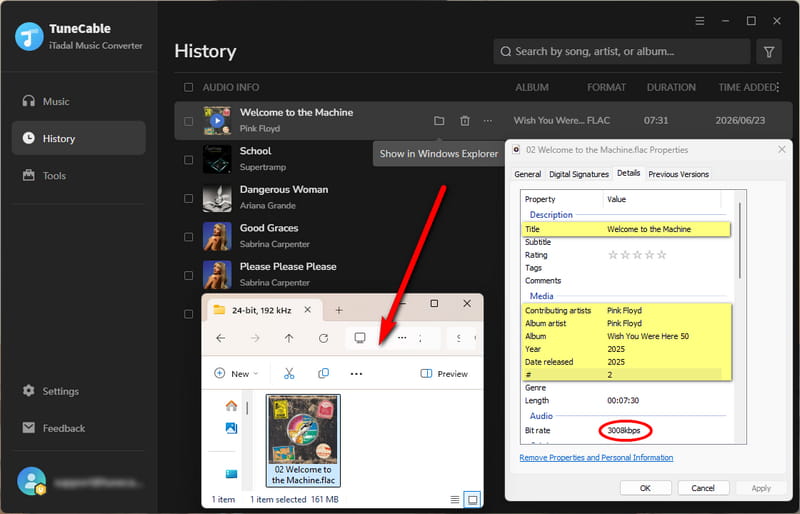
Also worth noting: if you're playing back on standard consumer gear, like Bluetooth speakers, regular earbuds, or phone speakers, you likely won't hear the difference between 16-bit and 24-bit. But for audiophiles with high-end DACs and studio monitors, preserving Max tier quality is a genuinely valuable feature, and TuneCable handles it properly.
🔷 2. Speed: Does 10X Hold Up?
I focused specifically on FLAC conversions, since that's what most Tidal users care about when preserving lossless quality. Here's what I measured:
| What I Tested | File Count | Format | Download Mode | Time Taken |
|---|---|---|---|---|
| Single track (4:12) | 1 | FLAC | App Mode | 22 seconds |
| Playlist | 50 | FLAC | App Mode | 19 min 36 sec |
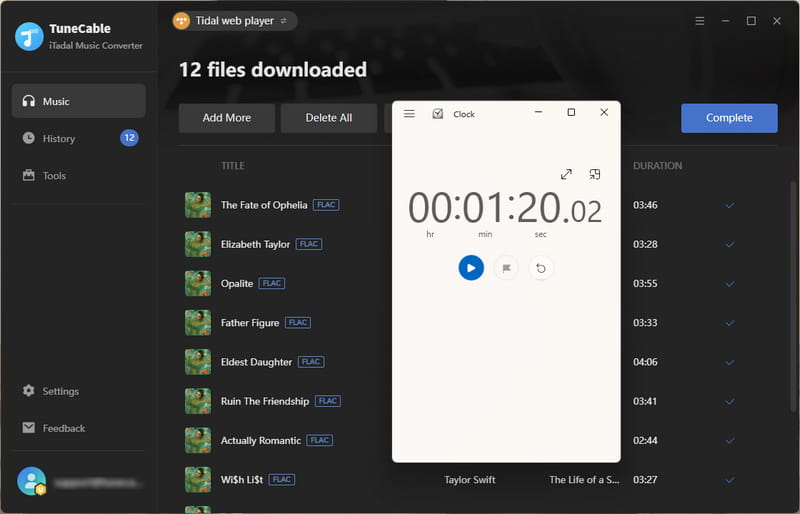
| Album | 12 | FLAC | Web Player Mode | 1 min 20 sec 💥 |
💡 Tip: TuneCable offers two download modes. Web Player Mode runs at up to 10X speed and supports High tier (16‑bit/44.1kHz). App Mode unlocks Max tier HiRes FLAC (24‑bit/192kHz) and runs slower. Choose based on your priority.
Here's the reality: FLAC files are large by nature, so conversion takes time. That said, both single tracks and entire playlists or albums convert quickly. And when using Web Player Mode, the speed is genuinely impressive.
What impressed me most:: batch processing remains stable throughout. There are no crashes even when queuing up 50 tracks at once. The speed doesn't degrade as the queue grows, which isn't something every Tidal converter can claim.
🔷 3. ID3 Tags: Did Everything Survive?
I checked 20 random tracks across various genres. Here's what I found:
| Track | Artist | Tags Preserved |
|---|---|---|
| Welcome to the Machine | Pink Floyd | Title, Album, Artist, Artwork, Track #, Disc #, Year |
| Taste | Sabrina Carpenter | Title, Album, Artist, Artwork, Track #, Disc #, Year |
| School | Supertramp | Title, Album, Artist, Artwork, Track #, Disc #, Year |
| Opalite | Taylor Swift | Title, Album, Artist, Artwork, Track #, Disc #, Year |
| Dangerous Woman | Ariana Grande | Title, Album, Artist, Artwork, Track #, Disc #, Year |
| Getting Older | Billie Eilish | Title, Album, Artist, Artwork, Track #, Disc #, Year |
| ... | ... | ... |
In every case, all essential ID3 tags were preserved correctly. The metadata matched what Tidal displayed, with no missing fields or incorrect data. This matters because without proper tags, your music library becomes a mess of untitled files that are nearly impossible to browse or sort. TuneCable handles this part cleanly, so your downloaded tracks are ready to drop straight into your existing collection without any extra cleanup work.
🔷 4. What About Ease of Use?
The interface is refreshingly minimal. You launch the software, log into Tidal, find your music, and hit convert. The whole flow takes about 30 seconds once you know what you're doing.
👍Key usability highlights:
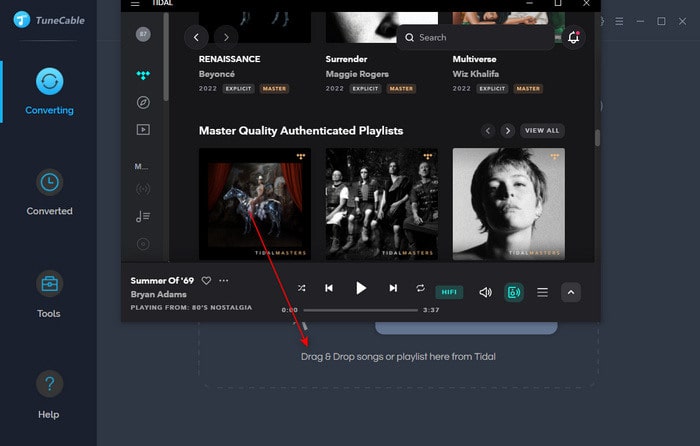
- Drag and drop from the Tidal app. If you're downloading from the Tidal desktop app, you can simply drag a song, album, or playlist directly from the app into TuneCable to start the conversion.
- Batch conversion. You can queue up an entire playlist or multiple playlists and let TuneCable process them all at once. Just walk away if you're busy.
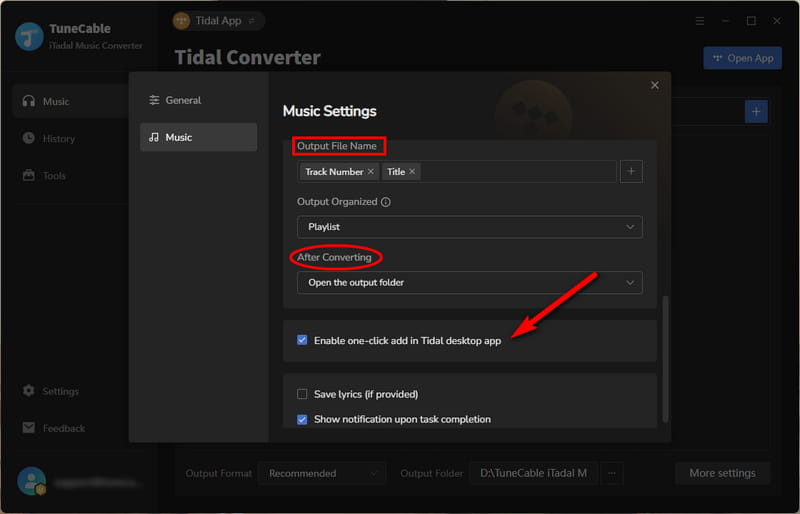
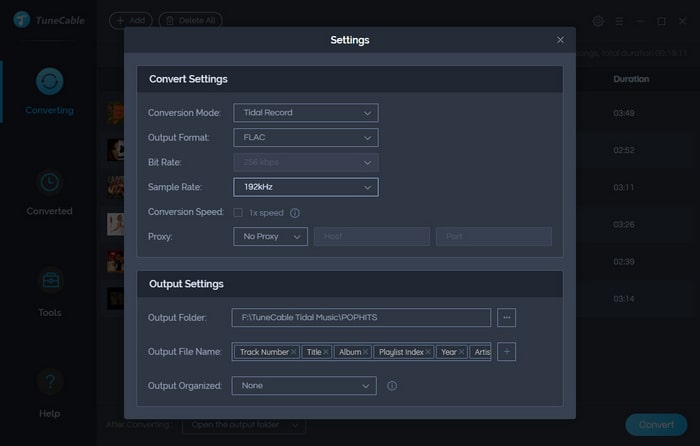
- Smart file naming. TuneCable lets you customize output file names using any combination of playlist index, track number, title, artist, or album.
- Auto‑open folder. Once the conversion finishes, the output folder opens automatically, so you can access your files right away.
Part 3. How to Use TuneCable to Convert Tidal to FLAC (Step-by-Step)
Getting started with TuneCable is simple. Here's my step-by-step walkthrough on how to download your favorite Tidal tracks in Hi-Res quality. Just a few clicks and you're ready to go. Click the button below to download and install TuneCable Tidal Music Converter first.
Step 1 Launch TuneCable Tidal Music Converter
After downloading and installing TuneCable on your computer, click to launch it. The pre-install TIDAL app will be summoned at the same time.
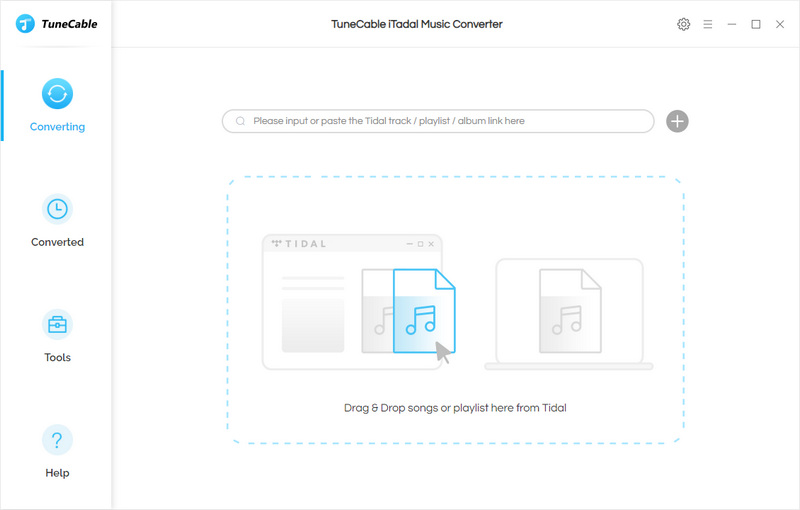
Step 2 Add Tidal Music Songs to TuneCable
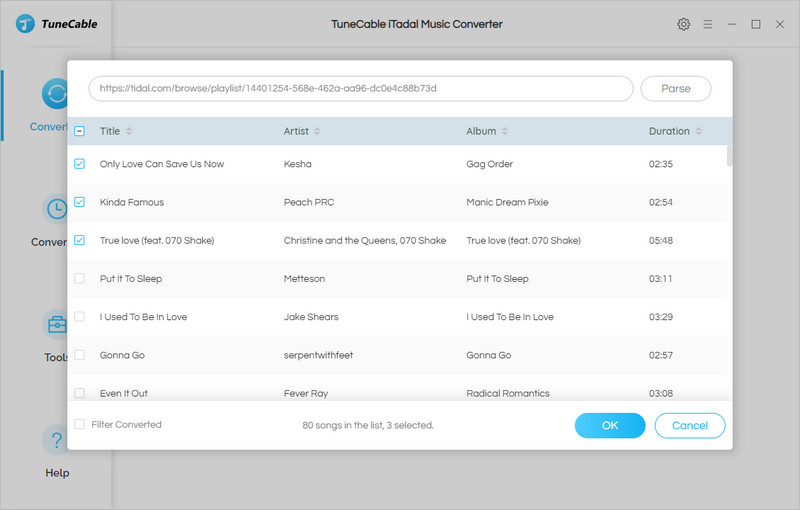
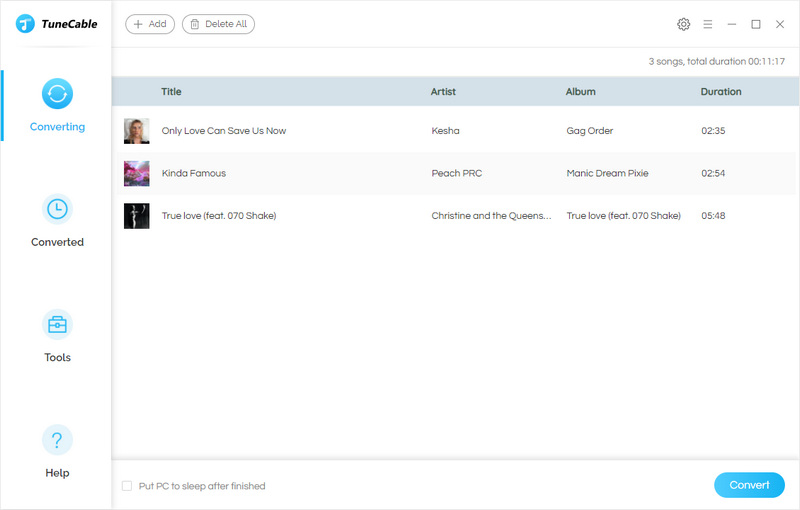
Head to your favorite songs, albums, playlists, artists, or other content on the Tidal Music app. Click and hold on to the title, then drag and drop it to TuneCable. The Tidal music converter will parse the link and load the songs on a popup, where you need to pick your target songs and click on "Add" to confirm.
Step 3 Modify Output Settings
Move to the "Settings" icon in the bottom left corner and click on it. Then the settings panel will appear. For Max quality, set your conversion mode to "Record Mode" and output format to "Recommended". Then customize the output folder, output file name, and choose a way to classify the output files.
Step 4 Start Downloading Tidal Songs to FLAC
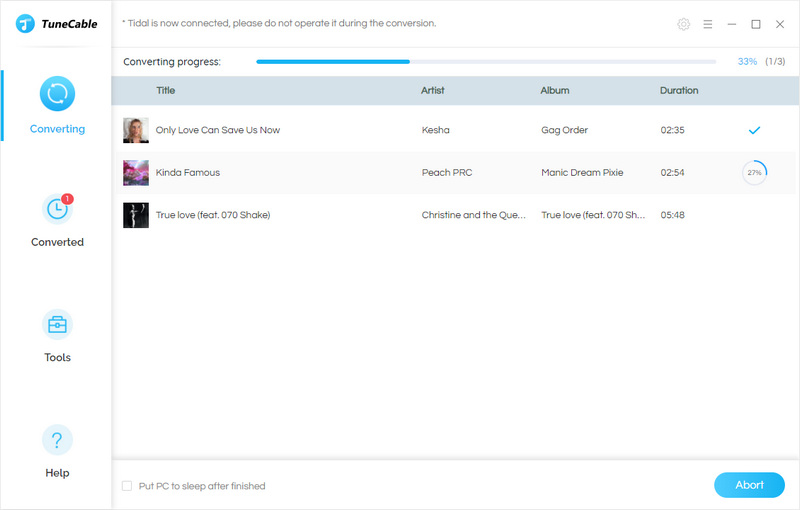
When all the preparations are done, simply click on the "Convert" button to download Tidal songs at once. When it is complete, you can go to the output folder to check the output Tidal music files.
Part 4. What Do Real Users Say? (Honest Trustpilot Roundup)
I combed through Trustpilot to see if my experience matched what other users are reporting. Here are some common criticisms.
1. Customer Support Delays
Some users expressed frustration with email support response times. One reviewer stated: "... I have sent 3 emails over the last 9 hours and have yet to hear from the support team".
My Take TuneCable's support is email-based, not live chat. Time zone differences can easily stretch a single exchange into a full day. If you're on a tight deadline, my advice is to reach out early and clearly explain your timeline. The team seems to prioritize time-sensitive cases once they understand the urgency.
2. Trial Limitations
A few reviewers were unhappy with the trial version's limitations. One user wrote: "This app is a scam, it allows only 1 minute of song..."
My Take The 1-minute download is a limitation of the trial version. The full version allows complete song downloads. This is standard practice for music converter software and isn't unique to TuneCable. If you're evaluating the software, keep in mind that the trial is meant to test functionality, not deliver full-length tracks.
3. License Delivery Issues
Some users reported not receiving their license key immediately after purchase. One reviewer stated: "No activation code sent after payment was made".
My Take TuneCable's official response to these complaints states that the license key is sent shortly after purchase and advises checking the spam folder. While these issues are frustrating, they appear to be isolated incidents rather than widespread problems. If you don't receive your key within a few minutes, the best course is to check your spam folder first, then contact support.
Final Verdict: Is TuneCable Worth It?
Based on my hands-on testing and the Trustpilot feedback I reviewed, TuneCable delivers on most of its core promises, but it's not without its quirks. The audio quality is genuinely lossless, the speed holds up well in most scenarios, and the interface is a pleasure to use. That said, the email-only support and occasional glitches are real drawbacks that could frustrate some users. Here's a quick breakdown of what I found.
| What Stands Out | What Falls Short |
|---|---|
|
|
Recommended for: Tidal subscribers who want offline access to HiRes FLAC files, audiophiles who care about preserving Max tier quality, DJs who need high-quality tracks for mixing, and anyone tired of paying monthly to "rent" music that disappears when they cancel.

Jacqueline Swift | Senior Writer
Related posts
